Cyprus Field Trip
Day 2 - 20 March 2015
"Our pilot is missing,” said Paul in his colourful language. Soon everyone was on board - including driver Andy - for a magical mystery tour. On the road again, Paul gave a continuous commentary on brilliant exposures of sedimentary rock revealing that we were passing through a million years of Cyprus' geological history. Road cuttings presented horizontally bedded chalks of the Lefkara and Pakhna Formations.
Site 1. North of Palodeia Village; a road cutting; the Yerassa fold and thrust belt.
Here, well-exposed chalks are almost vertical, sheared, contorted or even overturned due to a thrust fault accompanied by folding. Thrust faulting occurred when the African tectonic plate pushed northwards and collided with the Eurasian plate. On the opposite side of the road we found palagic chalk, river gravels (sedimentary rocks) and splendid bee orchids.

Moving on in our coach into igneous rock territory we observed pillow lavas on the roadside. "If there is no traffic it will be ok", said Paul as the coach climbed, passing sheeted dykes up to a high pass, followed by a spectacular descent through wild mountain countryside with purple saxifrage clinging to rock faces. The mountain scenery was formed by erosion during the Miocene, a period of very high rainfall. There was applause for Andy as we "landed'' safely at our next site. Was this the first ever crossing of the pass by a 50-seater coach?
Sites 2 and 3. West of Palaichori village; another road cutting.
Pat took a group photo with her i-pad here and emailed it to David and Heather, who had to cancel at the "last hour".
The west end of this cutting revealed dykes, which intruded dykes that intruded more dykes without any country rock in between them because there was a continuous supply of magma constantly pushing upwards. Such an assemblage is called a sheeted dyke complex and it is found at the centre of a spreading ridge. As a ridge spreads outward and dykes cool, fresh magma rises in contact with them on one side. Chilled margins with a finer grain size formed where there is a temperature differential at a junction between two dykes. One theory is that newer dykes chill only on one side, where contact was made with an older, cooler dyke. The edges also had a finer grain size. Significantly there were no intrusions into the country rock itself. We set about searching for the evidence of chilled margins with finer-grain material, lighter in colour though the verdict is pending on this one.
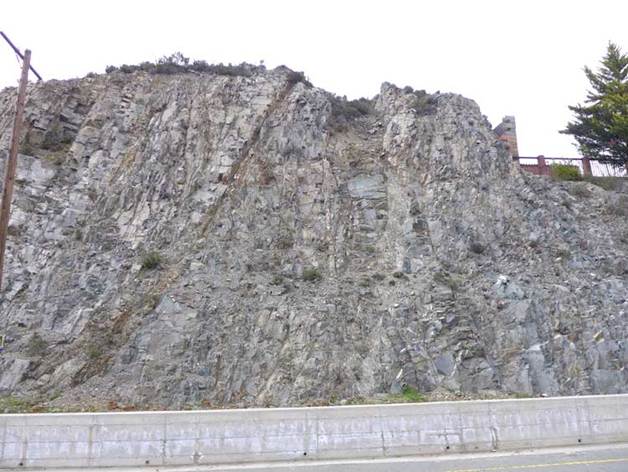
Paul continued to develop the igneous geological history and origin of the island and an apparent dilemma in the evidence. Although the lithological architecture is indicative of a Mid Ocean Ridge Basalt (MORB) the geochemistry disagreed and ultimately would provide the defining evidence
Returning to the present and the east end of the site there was an accumulation of leucocratic (a colour index of between 5 and 30) rock emplaced in surrounding dykes. This is plagiogranite, an igneous rock that is more felsic than the dykes, i.e. lighter in colour with feldspar, mainly plagioclase (anorthite). It is the product of differentiation of a magma richer in felsic minerals and less mafic ones. Black needle crystals of amphiboles were present and Paul had observed tiny grains of quartz crystals on an earlier occasion. The plagiogranite was emplaced as a small-scale plutonic body high in the sheeted dyke complex without chilling indicating that both were at similar relatively high temperatures when emplacement occurred, probably by a process of assimilation.
Site 4. South of Apliki village; a road cutting.
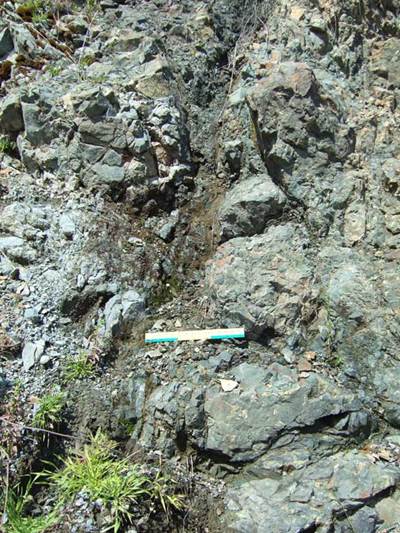
Dykes were evident on close identification. A darker coloured, more vertical feature ascending the exposed section was identified as a conduit, a component of hydrothermal plumbing. It was a feeder conduit for a black smoker vent. Hydrothermal fluids formed when seawater circulated through oceanic crust and became superheated at high pressure. The violent circulation of hydrothermal fluids caused brecciation of dykes with mineralization, the process by which rock is impregnation with minerals. Quartz and bright green epidotes were the main minerals formed. Sulphides were also precipitated from solution. Chalcopyrite (copper pyrites) and pyrite (fools' gold, iron sulfide) mineralization also occurred in veins.
Site 5. Arediou town; lunch stop at a taverna and a visit to a bakery for cakes. A bonus was a good view of the Kyrenia ridge from the bakery.
Site 6. The Akaki Gorge at Klirou Bridge; spectacular river cliff exposures.
There was another tricky movement for Andy as he deftly steered the coach across a narrow bridge to the next site. Some members of the party climbed above the river to get the best view of the exposures. Paul described it as a "perfect section of the upper oceanic crust". Most of the group just exclaimed, ''Wow''. I suggest you study the photograph from the viewpoint while you read the remainder of this paragraph.
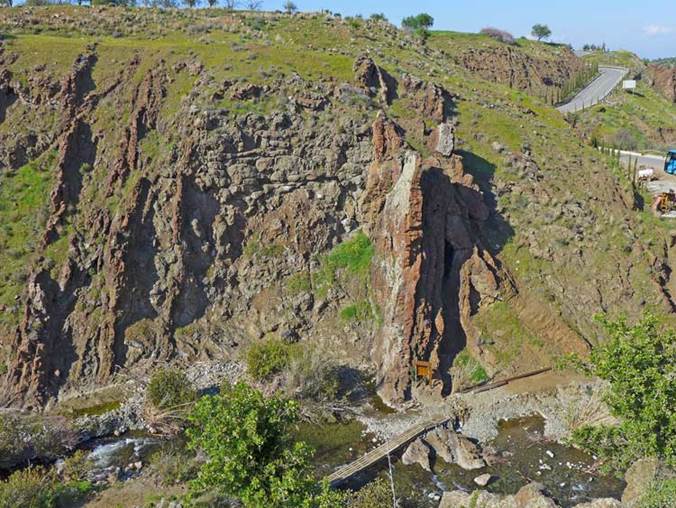
There is a particularly prominent rusty-red dyke on the far side of the river near the bridge with further less prominent dykes at different angles to the left. Some of these cut other dykes. They were also transected (cut across transversely) by pillow lavas with pillow breccia and hyaloclastites below them.
We climbed down to the river and explored the gorge floor, where we were walking through what was once the upper part of the oceanic crust. Chilled margins were evident on the dykes (see above). Paul explained that ''the dykes fed higher level volcanoes, with higher level pillow lavas subsequently removed by erosion during uplift of the ophiolite''. Pillow lavas with vesicles and amygdales (vesicles in-filled by minerals) were found in the gorge. Only the remains of a small lava tube were visible. A very long time ago it had been a conduit for lava but had been infilled by rubble. Broken pillow lavas had thick glassy rinds set in a dark matrix of hyaloclastites.
Hyaloclastites are aggregates of fine, glassy fragments. Hyalo means glassy and clastic means fragmented. They are formed when lava quenches on sudden contact with cold-water. Quenching is a process of supercooling that supresses any nucleation and subsequent crystal growth. The disordered state of a melt is frozen in the state of a solid that has the disordered structure of a liquid. The entropy (i.e. the order) of this glassy state lies between that of a crystal and a liquid. Volcanic ash is a similar material but forms by quenching in cool air, which is not as efficient as water as a quenching agent. Therefore, about 10% of volcanic ash is formed of crystalline minerals.
Fluids percolating through hyaloclastites can cause metasomatism and when the chemical reactions are exothermic sufficient heat is generated to support continued alteration. Paul explained "the complexity of volcanic artefacts is due to the precarious balance between rates of magma supply, extrusion and extension". The hyaloclastites found in the gorge show amoeboid spatter and micro pillows in a finer matrix. At one point a later small dyke had fused a section of hyaloclastite to a solid glassy mass. Sadly most of the hyaloclastites had been covered by recent human activity, which Paul regarded as geo-vandalism.
Jim found an interesting rock containing natural zeolites, which are silicate minerals that also originate from the hydrothermal alteration of volcanic protoliths. Zeolite minerals occur in isolated vesicles and veins and typically develop from hydrothermal solutions percolating through volcanic rock rich in cations. They are classified as alumosilicates, a group of hydrous framework tectosilicates with voids that contain water and "mobile" cations to balance electrical charge.
Site 7. Mathiatis Opencast Copper Mine.
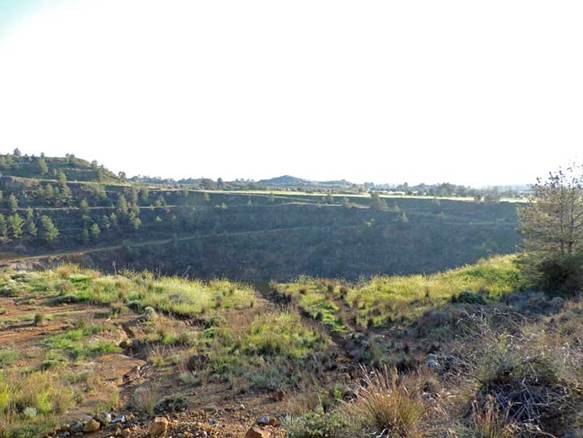
Mining for copper on a small scale dates back to the Roman occupation. This open cast mine was enlarged between 1920-1940s and has been made safe for public access. The Phoenicians also mined copper on the island and depleted the forests using the wood to extract the metal from ores, a process known as refining. Numerous slag heaps indicated that copper ores were smelted on site. The ores formed in the final stage of black smoker activity when seawater percolated through fractures in pillow lavas and formed exhalative sulfide mineral deposits. A silvery specimen of marcasite, a polymorph of pyrite (FeS2) was found though it is rare in hydrothermal deposits and more common in sedimentary rocks. Sulphuric acid is a by-product formed by oxidation of sulfides to sulphate and is potentially harmful to the environment (acid rock/mine drainage). Gypsum (calcium sulphate) formed as a secondary mineral by reaction between carbonates and the acid. For further details on hydrothermal processes and mineralisation there is more information on the Internet under ''pillow lava mineralisation (Cyprus)".
The clouds lit up in the setting sun with their rims highlighted in gold and Bill recalled the saying, ''Every cloud has a silver lining''. Paul resumed his discourse on the igneous history of the island. There is an apparent dilemma in the evidence about the origin of the Cyprus ophiolite. Most rocks melt at different temperatures. When peridotite is heated the composition of the initial melt differs from that of the rock. It is richer in calcium and silicon though is depleted in magnesium as it becomes less ultramafic and more mafic. It is expected eventually to become basalt though Paul hinted that in the next stage this melt would become rich in magnesium-bearing silicates and left us with a real cliffhanger.